
Quick answer
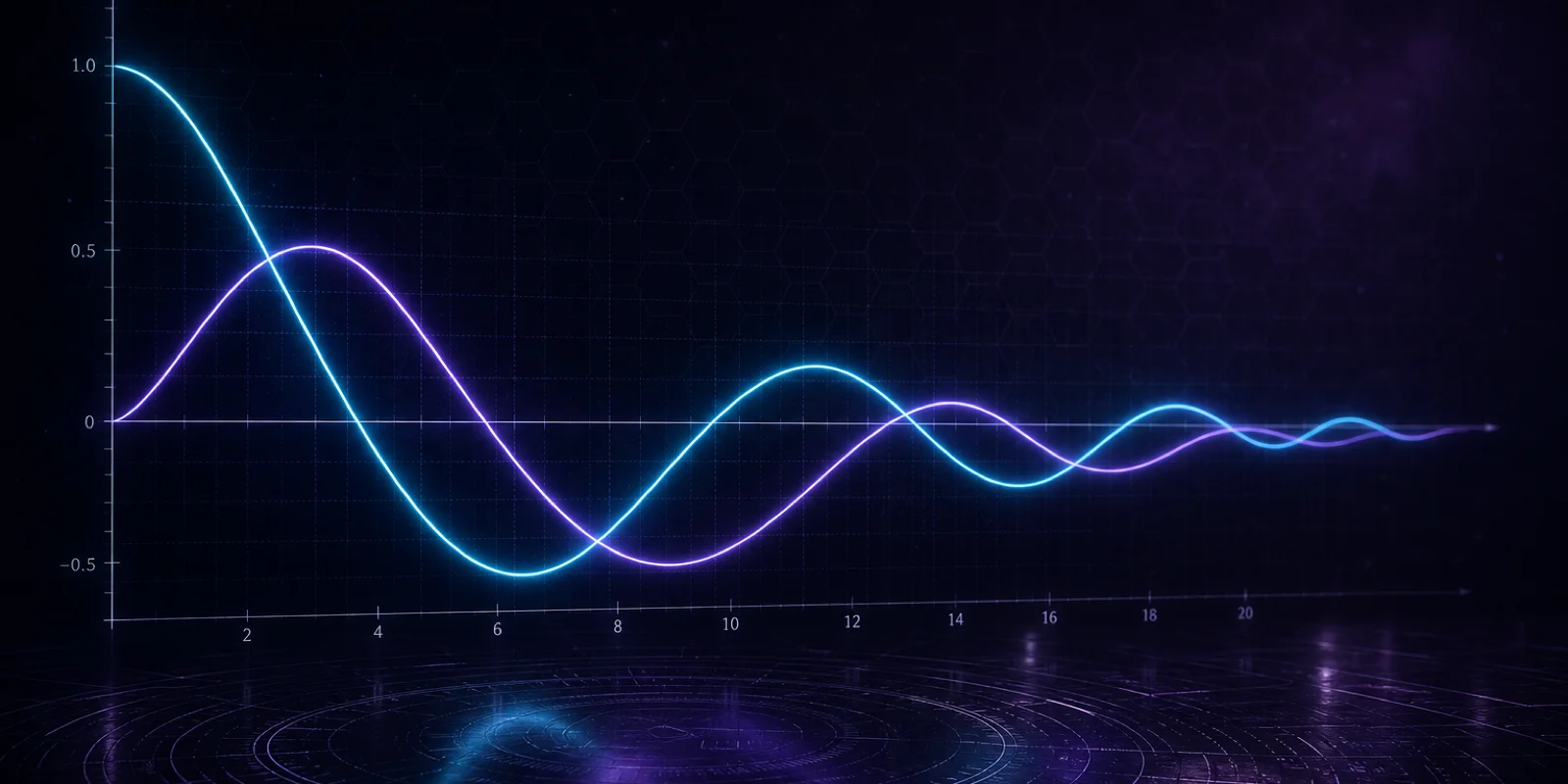
Bessel functions satisfy x2 y'' + x y′ + (x2 − v2) y = 0. Integer-order Jn(x) can be written as a power series, and neighboring orders link through standard recurrence relations.
Formula
- Series (integer n ≥ 0):
- Jn(x) = Σm=0^∞ (−1)^m (x/2)n+2m / (m! (n+m)!)
- Recurrence: Jn−1(x) + Jn+1(x) = (2n/x) Jn(x)
Introduction
Formulas for Bessel functions appear in two flavors: the differential equation that defines them, and the identities that let you move between orders without re-deriving series. Both are worth keeping next to your calculator tab while you work through homework.
If you are new to the topic, read what a Bessel function is first. This page assumes you know that Jv(x) is the bounded solution at the origin.
Engineers often need recurrences to convert derivatives of Jn into Jn±1. Students meet the series definition in mathematical methods courses. Either way, a quick numeric spot check prevents sign errors that propagate through an entire design calculation.
When you are ready to turn a formula into a decimal, the how to calculate Bessel functions guide compares series, asymptotics, and library methods for different ranges of x.
Keep a short list of the three relations you use most often: the defining equation, one recurrence, and the derivative formula. Everything else can be looked up when a boundary-value problem demands it.
Which formula should I use?
Use the differential equation when you are setting up a boundary-value problem or proving orthogonality. Use the series when you need a rough magnitude for small x. Use recurrence relations when you differentiate or integrate expressions containing Jn.
For non-integer v, the series still exists but factorials become gamma functions. Software and the on-site calculator handle those cases directly so you do not need to expand gamma functions by hand.
Modified Bessel functions obey a different equation with a minus sign on x2. Do not mix their formulas with Jv unless you have already changed variables and confirmed which equation your model produced.
Integral representations connect Jn to trigonometric integrals and are useful in proofs. For numeric work they are rarely faster than calling a library, but they explain why Fourier methods and Bessel modes appear in the same course.
Generating functions package an entire family of orders into one power series in a parameter. They are elegant on paper and occasionally useful when you sum over modes in statistical mechanics or signal processing.
Core identities (integer n)
- Jn−1(x) + Jn+1(x) = (2n/x) Jn(x)
- d/dx Jn(x) = (1/2)(Jn−1(x) − Jn+1(x))
- J−n(x) = (−1)^n Jn(x) for integer n
The derivative formula explains why electromagnetic boundary conditions often couple three orders at once. When you implement a solver, you can generate Jn±1 from Jn using these lines instead of calling the library three times with unstable differencing.
Zeros of Jn(x) do not have elementary closed forms, but they are tabulated and show up whenever a mode condition reads Jn(β a) = 0 for a disk or waveguide radius a.
The Lommel expansions and Neumann addition theorems are advanced tools for multiplying Bessel functions. Most undergraduate problems stop at the recurrences above plus orthogonality on finite intervals.
When x is large, asymptotic expansions replace the series. They are poor near zeros but excellent for estimating envelope decay in radiation and scattering estimates.
Apply a formula without algebra mistakes
- Write the targeted identity Copy the relation exactly, including signs on subscripts. Off-by-one errors in n are the most common slip.
- Substitute your x and n Keep x dimensionless. If the formula divides by x, check that you are not at x = 0 unless you take a limit.
- Evaluate each term on the calculator Compute Jn−1, Jn, and Jn+1 in real mode at the calculator and verify both sides numerically.
- Differentiate numerically if unsure Compare (Jn(x+h) − Jn(x))/h with the derivative identity for a small h. Agreement within a few significant figures builds confidence.
- Archive the check Save one screenshot or note with v, x, and both sides of the identity. Reviewing it before an exam takes seconds and prevents repeated mistakes.
Example: recurrence at n = 1, x = 3
The relation J0(3) + J2(3) = (2/3) J1(3) should hold to machine precision. On the calculator, J0(3) ≈ 0.2600, J1(3) ≈ 0.4101, J2(3) ≈ 0.0584, and (2/3) J1(3) ≈ 0.2734. Summing J0 + J2 matches the right-hand side.
This single check catches wrong subscripts faster than redoing a long derivation. Repeat at x = 1 and x = 5 to see that the identity is not tied to one lucky point.
For the derivative identity at n = 2 and x = 2, compare the calculator value of J′_2(2) with (J1(2) − J3(2))/2. Disagreement usually means a transcription error in the formula, not a bug in the tool.